Policy of decentralized management – AREF Rabat-Salé-Zemmour-Zaers
This morning we woke up bright and early to make-up the Quality Workshop that we missed last week. Fortunately, our hosts at the Academy for Education and Training (AREF) were gracious enough to meet us earlier to accommodate our busy schedule. As I’m sure Meaghan will provide more details, the short version is that in the process of decentralization, Morocco created regional entities known as AREFs. Each AREF branch operates as an autonomous, independent organization, and we were meeting with some of the staff at AREF-Rabat.
The first thing that I noticed upon arriving was that the building was very much a work in progress. There was still talking plastic on the walls, dust on the stairs, masking tape on the door knobs, and the scent of fresh paint permeated the air. There were even a handful of handymen on ladders completing last minute projects.
 |
| Moroccan who got Tom Sawyer-ed |
As we were climbing up four narrow flights of stairs, I wondered whether the elevator was functional yet. That said, it was clear that the end product was going to be beautiful, as evidenced by the killer view on the top floor. Additionally, despite the “Please excuse our appearances” downstairs, the office was well-equipped with what appeared to be a lab, whiteboards, and a desultory assortment of computer equipment. Everything about the place screamed modern, contemporary, and open.
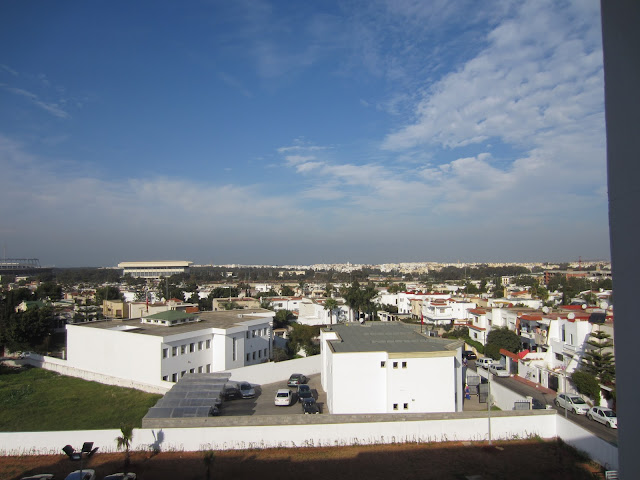 |
| A view from the top floor |
This spacious environment seemed to reflect the wide influence and leadership style of Mme. Tijania Fertat, the sassy but inspirational female director who gave a wonderful presentation about some of the ongoing reform projects in Rabat. The initiatives to promote art, culture, and science in Rabat schools struck me as particularly progressive and innovative. In past meetings, we heard a lot about the pedagogy of integration and 21st Century Skills, but it was great to see actual examples of programs that were implemented successfully.
In the case of AREF-Rabat, it seemed that competitions were a particularly successful method of fostering school culture, whether it was a “Cleanest School Contest,” an art exhibition, or a filmmaking contest.
A unique characteristic of Rabat is its reliance on partnerships with local NGOs and private businesses. Although the MoE provided a yearly budget, this AREF had taken it upon itself to subsidize its operations with outside private funding (I got the impression that a large part of its success in fundraising stemmed from Mme. Fertat’s gumption). She mentioned, somewhat exasperatedly, that since they were still in the process of transitioning to a decentralized system, the MoE still exercised quite a bit of control over the budget and contracting decisions. The concept of government money “with strings attached,” immediately reminded me of Race to the Top, in which states compete for federal grant money. Although the AREFs don’t seem to be in direct competition with eachother for funds, there does seem to be an issue regarding the equitable distribution of resources. According to the director, the perception of Rabat as a privileged and urban region has resulted in less government assistance. As such, they have been forced to rely on outside sources, and they were fortunate enough to be within close proximity to several corporations or NGOs within the community. These partnerships have given way to successful projects such as renovating schools, a center for innovation, and science equipment. It does raise the question, however, about more AREFs in areas that may lack the support of private companies or nearby organizations. As I was enjoying the warmth of the brightly-lit conference room (this office was the first Moroccan building where we have experienced an electric heater), I was convinced that there is no way all AREFs enjoyed such beautiful facilities. Where does decentralization leave them? Sometimes I wonder whether the overexcitement for deregulation or regionalization often leads to missed opportunities for information sharing or creating a common knowledge base. This is true at the macro national level, but it’s even true at Harvard University, in which there is little communication or collaboration between schools.
Office of Quality Management
We were all eager to return to the MoE for our make-up session with the Office of Quality. As you know, the unifying theme among all three IEP trips is Implementing Quality in Education, and we wanted to emphasize it on this trip. Not to mention that we also just felt awful for missing our original Friday meeting, since Moroccans are just so darn kind and welcoming. This panel was no exception, as the Director of Quality opened with a beautiful and poignant reference to Jefferson’s “Pursuit of Happiness” which actually elicited a rare mid-presentation round of applause.
The Office of Quality Management was only established in 2009, so the structure and framework of the organization is quite impressive, given its relative newness. We were fortunate enough to have the participation of several departments, specializing in various sectors such as Manuals, Evaluation and Auditing, and Teacher Quality Training. It was a remarkably well-organized presentation that featured representatives from various departments.
One section that I found particularly fascinating was their use of international frameworks (from Europe, North America, and Japan) as references. They discussed the process of selecting aspects which were appropriate for the Moroccan context, while being sensitive to the particularities of Moroccan culture and history. It was a page straight out of
Fernando Reimers'
Lessons in Educational Equality regarding the framework of contextual transfer. The Moroccan bright spots were chasing international bright spots. It’s all very meta.
 |
| This photo is also very meta |
One point I will make is that in education policy, it is so easy to fall into the trap of jargon quicksand. As an English major, I’ve been trained to be as concrete and precise as possible, so abstract, undefined terms such as “systems,” “assessment,” and “learning” kind of annoy me. At some point, “implementing system,” “maintaining systems,” and “sustaining systems” become either interchangeable or meaningless to me. What does an “education quality evaluation system” actually look like? Apparently I wasn’t the only one who was grasping for something concrete throughout the presentation, since Mark took it upon himself to create a word bank for “Education System Mad Lib.” We’re playing it next game night. So to future education practitioners: Complicated flowcharts and Redundant, Abstract Vocabulary = bad. Visual collateral (videos, brochures, manuals, etc) = good.
Azeituna Preschool
On a closing note, I wanted to give a shout out to the wonderful people at Azeituna preschool. In addition to generously lending us their school bus (and driver!) to cart us around the streets of Rabat, they were kind enough to meet us late in the evening to take a tour of their school. After sitting through a series of formal meetings and presentations, it was very refreshing to visit an actual school where all the policy and theory comes together. This particular preschool seemed to do a great job in staying abreast of issues regarding early childhood education. Everything from the language of instruction to the architectural design were deliberate decisions to further the school philosophy and mission. I know Meaghan is going to gush about that experience, so brace yourself for some visually stimulating, colorful photos!
P.S. Happy Birthday to my Moroccan Roommate Afi!
P.P.S. Did I mention that we saw the King of Morocco? Because we did.


